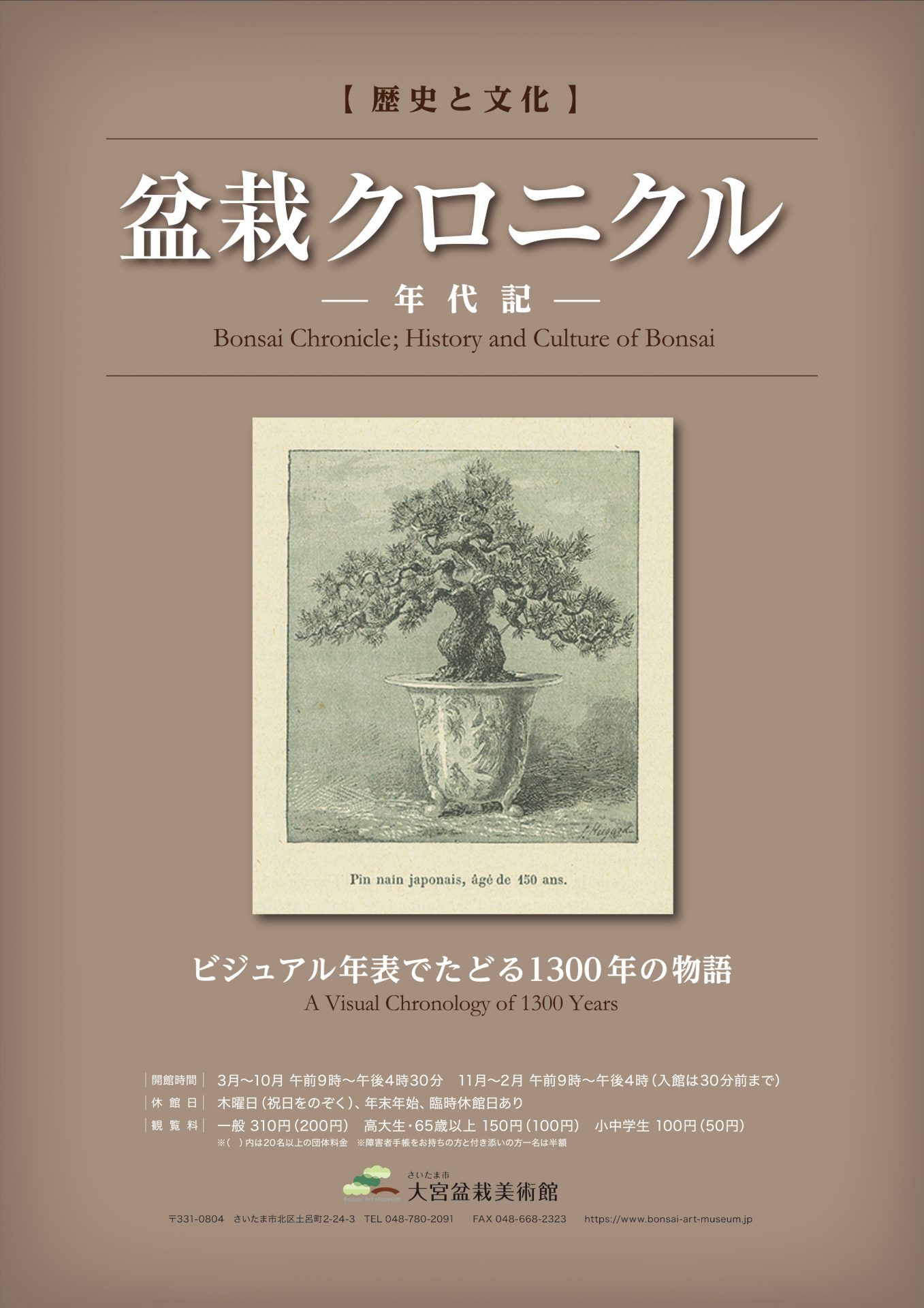
Bonsai Chronicle; History and Culture of Bonsai
Date:Sat. September 12, 2026 ~ Wed. October 7, 2026
Place:Exhibition Room
A Visual Chronology of 1300 Years.
Bonsai is a traditional Japanese art form that has spread around the world.
In the long history leading up to the present day, how has bonsai been created, what has it been called, and how has its tradition been nurtured?
This exhibition traces the history of bonsai over 1,300 years, introducing the path that bonsai has taken from Japan to the rest of the world through a chronicle-styled panel display with a wealth of visual materials.
In the center of the exhibition room, selected works and materials from the museum’s collection will be displayed according to the season in which the exhibition is held.
While enjoying the bonsai of the season, we hope that this exhibition will also grip you by the history and culture of bonsai, which continues to this day.
Collection Exhibition
May 15-July 1, 2026
Bonsai Pots
- Unknown, Flower-Shaped Cochin Pot with Embossed Lion Heads, Qing Dynasty (17th-19th c.), flower-shaped pot with outer rim (B-043)
- Heian Kozan, Cobalt-Blue-Glazed Pot with Kinko Carp Design, Showa Era (1926-89), rectangular pot with outer rim (B-279)
Paintings and Pictures
- Utagawa Toyokuni III, A Scene from the Kabuki Hachiman Festival, first printed June 1860, three pieces of large paper (E-006)
- Toyohara Kunichika, Niō-no-miya, August 1884, large format paper (E-144)
Historical Materials
“Gardening in the Edo Period: Passion for Rare and Unique Plants (Kihin)”
- Mizuno Tadatoshi (author), Ōoka Unpō and Sekine Untei (illustrators), Sōmoku Kin’yōshū, 1880 (first printed in 1829), seven volumes (F-004)
- Kinta Masuda (compiler/editor), Ōoka Unpō and Sekine Untei (illustrators), An Illustrated Guide to Kihin (Rare Plants), 1827, three volumes (F-197)
Thematic exhibition
50th Anniversary of the U.S. National Bonsai & Penjing Museum – A Journey Through Its History
March 20-May 13, 2026
In August 2019, the Omiya Bonsai Art Museum, Saitama, formed a sister-institution partnership with the National Bonsai & Penjing Museum, located within the U.S. National Arboretum in Washington, D.C. With the aim of promoting exchange between the United States and Saitama City through bonsai and enhancing the cultural value of bonsai, the two institutions have continued to share information and collaborate in various ways.
The National Bonsai & Penjing Museum was established in 1976 as a public display facility following the donation of 53 bonsai trees and 6 suiseki from the Nippon Bonsai Association to the U.S. government. This year (2026) marks the milestone 50th anniversary of its opening.
This panel presents the background behind the establishment of the museum—an event of great significance from a cultural-historical perspective that highlights the internationalization of bonsai.